Three millimetres, six or ten: reading a stud size before you buy it
A stud has one measurement and product photographs hide it, because a 3mm ball and a 10mm ball both fill the frame. What each size looks like on a lobe, which sizes suit a second piercing, and how to check with a ruler in a mirror.

One number, and why photographs hide it
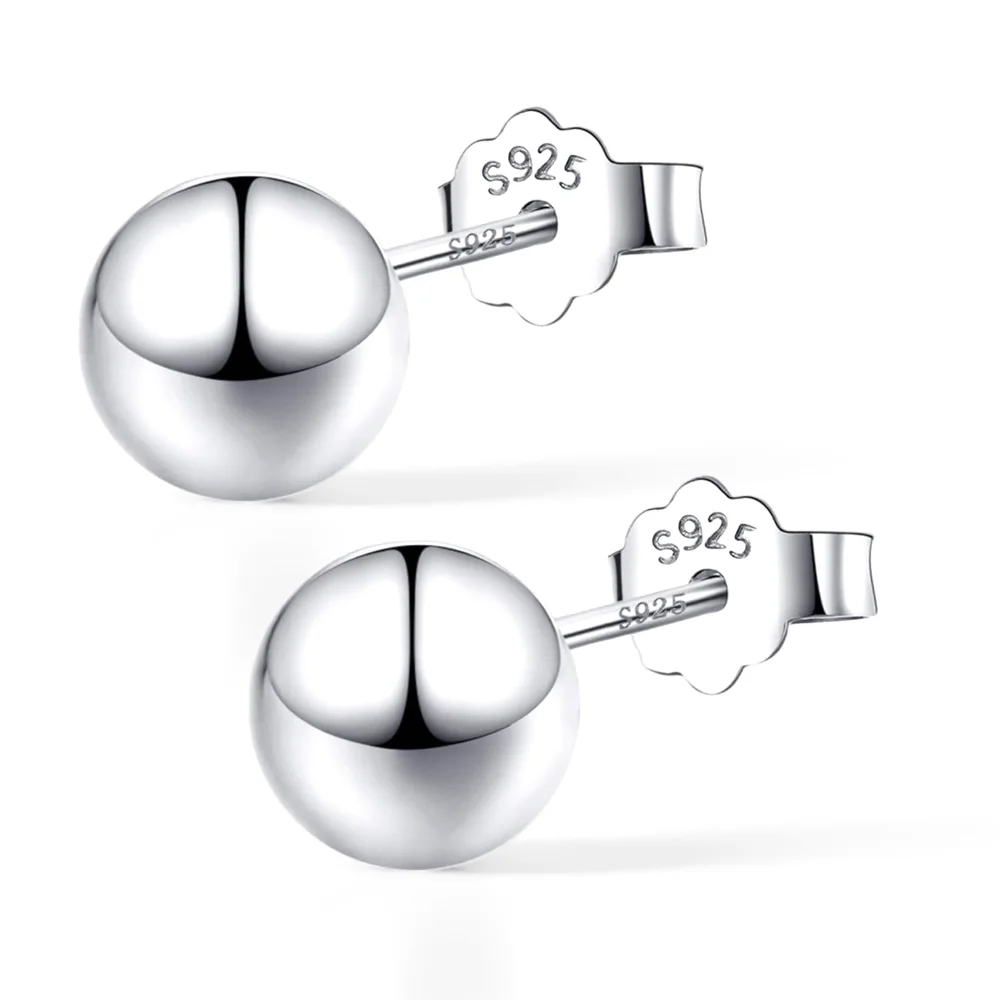
A sterling silver stud is described by a single number. That number is the diameter of its face, a measurement taken straight across the front of the piece. Everything else about the stud, the post, the back, the material, can be identical, but this one dimension changes the entire presence of the jewellery on your ear. It is the most important figure to know before you choose, yet it is also the easiest to misunderstand from a product page. Photographs are the primary reason for this confusion. Our catalogue, like every other, frames each stud so it fills the image. A three-millimetre ball and a ten-millimetre ball will appear to be the same size on screen because both are shot as close-ups. The scale is lost. Context vanishes. This presentation is necessary to show the details of the metal and the finish, but it strips away the very information you need to judge proportion. You are not looking at the stud in relation to your own earlobe. Instead, you see an isolated object, magnified to an arbitrary degree. The number printed in the specifications is the only reliable anchor. Learning to read that number, and to picture it on your skin, is the first step. All of our ball studs, from the smallest to the largest, share the same construction of 925 sterling silver and a standard ten-millimetre post. The face diameter is the variable that defines them. It is a simple, precise piece of data that marketing imagery deliberately obscures for the sake of visual consistency across a collection. Trust the millimetres, not the pixels.
What each size looks like on an ear
Visualizing a measurement requires a frame of reference. On an average adult earlobe, a three-millimetre stud presents as a subtle gleam. It is a pinpoint of light, a discreet accent for a single piercing or a quiet addition to a stack of several. This size is often chosen for a second or third hole where understatement is the goal. Moving to four or five millimetres, the stud gains more presence without becoming dominant. A five-millimetre ball is a clear, definite sphere, easily noticeable in a conversation. It represents a popular middle ground. At six millimetres, the stud becomes a statement. It occupies a significant portion of the lower lobe and carries a visual weight that draws the eye. For an eight-millimetre stud, the face covers nearly the width of many lobes. At that width the pair reads from across a room, which is the whole reason people buy it. Our druzy studs at eight and twelve millimetres offer a different texture but follow the same scale. A ten-millimetre ball is substantial, bordering on dramatic, and suits those who prefer their jewellery to be a focal point. The twelve-millimetre druzy is the largest face in our catalogue, and at that width the crushed crystal is the first thing anyone sees. Your own anatomy, of course, dictates the final effect. A six-millimetre stud on a small lobe will appear much larger than it would on a larger ear. Proportion is personal.
| Millimetre Size | Compares To | Often Chosen By |
|---|---|---|
| 3 mm | Pin head | Those with multiple piercings, or for a subtle first stud. |
| 4 mm | Small pea | Anyone seeking a balance between visibility and discretion. |
| 5 mm | Standard pea | A classic, all-purpose size for a primary lobe piercing. |
| 6 mm | Large pea | Individuals who want a clear, solid statement piece. |
| 8 mm | Pencil eraser | Those preferring bold, traditional studs or a druzy surface. |
| 10 mm | Large pencil eraser | Wearers who enjoy a substantial, eye-catching look. |
| 12 mm | Small coin | For a maximalist accent, typically with a druzy design. |
Measuring without a jeweller
You can determine your ideal stud size with ordinary tools. No professional appointment is necessary. The most direct method involves a ruler and a mirror. Hold a millimetre ruler flat against your earlobe while looking into the mirror. Position the zero mark at one edge of your lobe and note the measurement at the other edge. This gives you the approximate width of the canvas. A stud that is half to two-thirds of this width will usually sit comfortably within the bounds of your lobe. For example, a lobe measuring twenty millimetres wide accommodates a ten-millimetre stud with a pleasing margin of skin visible around it. Another practical technique uses a stud you already own and like. Remove it and place it on a flat surface. Lay a ruler across the face of the stud, measuring from one side to the other. This gives you its exact diameter. Knowing the size of a piece you find visually successful provides a perfect baseline for your next purchase. If a four-millimetre stud feels too small, you might try a six. If an eight-millimetre one feels overwhelming, a five could be the answer. These are empirical methods that remove guesswork. They translate the abstract number into a tangible reality specific to your ear. Comparing the measurement to everyday objects can also build intuition. A three-millimetre ball is scarcely larger than the head of a pin, while a ten-millimetre one is about the width of a standard pencil eraser. This contextualization helps bridge the gap between a number on a screen and the object that will sit on your body.
The post, which nobody photographs
While the face of the stud gets all the attention, the post does all the work. It is the hidden component that determines fit, security, and comfort. Our sterling silver studs all use a ten-millimetre post as the standard for adults. This length is a compromise designed to fit the greatest range of earlobe thicknesses. On a thin lobe, a ten-millimetre post will protrude slightly from the back, allowing the butterfly back to grip the very end of the post. A little silver will be visible behind the ear if you look closely. On a thicker lobe, the same post will seat fully, with the back sitting flush against the skin. It works either way. The butterfly back itself is a friction-fit closure. It slides onto the post and holds in place by pressure. Over many months of wear and removal, the metal of the back can gradually loosen its grip. This is a normal occurrence, not a fault. Replacement backs are inexpensive and widely available, making it simple to maintain a secure fit indefinitely. Photographs almost never show the post because it is functionally identical across styles. It is the dull half of the pair, and the half that decides whether the earring is worn. Yet understanding this part of the mechanism is crucial. A post that is too short will not penetrate a thick lobe, while one that is excessively long may feel clumsy or catch on clothing. The ten-millimetre standard has been adopted because it avoids both extremes for most people. Fit came first, and the part nobody photographs is where that decision was made.
Second holes, cartilage and children
Choosing a size for a lobe piercing follows one logic. Choosing for a second hole or a cartilage piercing follows another. The placement dictates the proportion. A second piercing typically sits higher on the lobe, in a space that is often narrower than the lowest point. A large stud in this location can look crowded. Consequently, smaller diameters between three and five millimetres are common choices for second and third holes. Graduated that way, each piece has room of its own instead of competing with the one below it. Cartilage piercings, such as helixes or conches, present a different anatomy. The cartilage is flat and firm, offering a shallower platform than the soft, dangling lobe. A large, heavy stud can press uncomfortably against the side of the head. Smaller, flatter profiles are therefore the norm. While our collection focuses on lobe studs, the principle of scale remains. A five-millimetre stud would be considered quite prominent on a helix. For children, the considerations are both anatomical and practical. Younger lobes are smaller and more delicate. A large, heavy stud is disproportionate and can be uncomfortable. A smaller, lighter stud is a safer, more comfortable option. Furthermore, professional piercers universally advise leaving the initial jewellery in a new piercing until it has fully healed, which can take several weeks. The choice of the first stud is therefore often made with healing, not fashion, as the primary concern. This is a matter best discussed with the piercing professional or a clinician.
Weight, and the reason a large ball is not heavy
The diameter of a sphere increases its volume, and thus its potential weight, exponentially. A ten-millimetre ball has a much larger volume than a five-millimetre one. If both were solid sterling silver, the larger stud would be prohibitively heavy, causing the earlobe to droop and potentially leading to discomfort or stretching over time. Jewellery design addresses this through hollow construction. A large ball stud is typically not a solid mass of metal. Instead, it is a hollow sphere, often made from two hemispherical shells joined together. This technique drastically reduces the weight while maintaining the visual impact of the size. The perceived heft of a large stud is therefore mostly an illusion. It looks substantial because of its diameter, but it feels light because it is mostly empty space. This is a crucial piece of engineering that makes wearing a statement piece practical for all-day comfort. You can enjoy the bold appearance of an eight or ten-millimetre ball without the physical burden a solid piece of metal that size would impose. The weight does not scale linearly with the size. Our sterling silver studs are designed with wearability in mind, using methods that have been standard in jewellery-making for generations. The goal is always a piece that feels as good as it looks, from the smallest, solid pinhead to the largest, hollowed form.
More like this is in Silver Notes, and the people at EVERU keeps the whole range one click away on the front page.